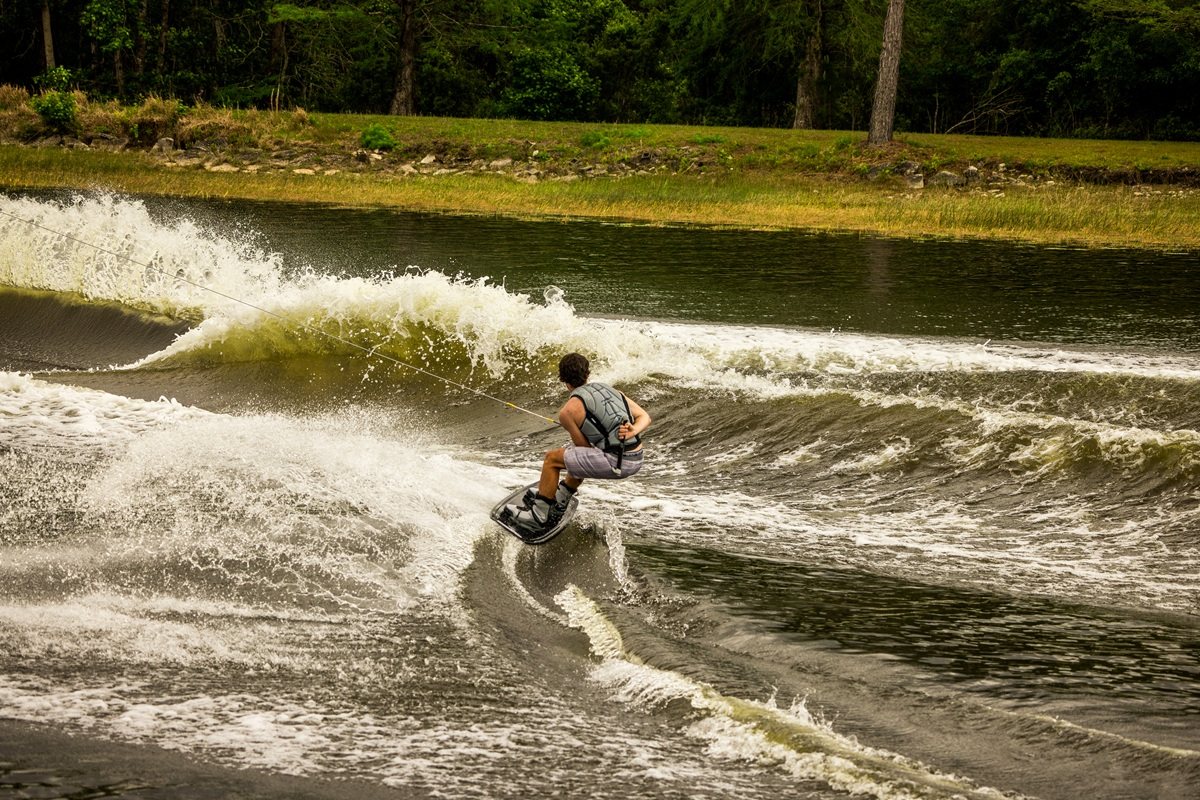
Your gear plays a huge role in your success on the water. For beginners, it’s all about ease of use and comfort. Look for a twin-tip wakeboard with a wider profile and soft, beveled edges. This makes it easier to balance, turn, and avoid catching an edge. Most beginner boards come with removable fins for added stability and control. But we recommend keeping those fins on! A nice stable board, with rounder edges like the Liquid Force TRIP wakeboard is an excellent choice for a first time wakeboarder. You will almost certainly peel your eyelids back when you catch your toe side edge and slam headfirst in to the water, so do it on a friendly board that will help minimize these slams ????
Entry-level wakeboard bindings usually come in fairly adjustable sizes. A small usually covers a 4/8, the standard 7/11 and the XL covers 10/14. Some brands vary. More advanced boots are stiffer, and more size specific, offering higher performance for the individual user, but less adjustability for a group. A more basic open toe boot is usually a better choice for a beginner; it shares with the group easier, is easy to put on and off, and will release you in a fall a bit more readily as well. Pair that friendly Trip wakeboard up with the very comfortable Liquid Force INDEX wake boots for a sweet package that won’t limit your progression and will allow you to share with the family!
- Stance width: Shoulder-width apart centered on the board
- Stance angle: Try a 9–15° duck stance for each foot
- Board length: Based on user weight range (ex. 135cm board for 150 lbs rider, 145 cm for 250 lbs… board length may change based on skill level and user preference)
- Boot size: Based on user shoe size
Basic Wakeboarding Terms Every Beginner Should Know
Understanding wakeboarding terms will help you communicate better on the boat with your buddies and with your coach. There is nothing worse than being in the water and hearing your coach say, “Yo dude, you were like fully stoked hittin' that buttery wake, until you ate it harder than my GPA freshman year, straight-up scorpion’d in front of the gnarly boat babes brah!”, and you have no idea what they said to you. If you want to learn Tantrum to Blinds you must learn the lingo...BRO!!
|
Regular Stance |
Left foot forward |
|
Goofy Foot |
Right foot forward (I know you are goofy, but what foot forward are you? har har har…) |
|
Heelside |
Cutting with your heel edge facing the wake |
|
Toeside |
Cutting with your toe edge facing the wake |
|
Switch / Fakie |
Riding with your non-dominant foot forward |
|
Progressive Edge |
A gradual increase in edge pressure as you approach the wake |
Teaching The Deep Water Start
The deep water start is the foundation of every beginner wakeboarder’s journey. Luckily, it’s easier than you think! To get started with a deep water wakeboard start, begin with the board perpendicular to the boat, I know… I know, don’t worry! It’ll naturally straighten as you start moving. Hold the handle with a palms-down grip and keep the rope positioned between your feet. Pull your knees into your chest and tuck your elbows to your knees for stability. As the boat begins to pull, lean slightly back with equal weight on both feet, keep your arms straight, and hold the handle low and close to your hips. Most importantly… let the boat do the work. Staying in your tight body position, with straight arms, the boat will pull you up on top of the water. Once you're gliding on the surface at slow speeds, stand up slowly into an upright riding position.
If you're falling forward, it's likely because you're standing up too early, stay crouched a hair longer and let the boat do the heavy lifting.
Plowing through the water? That’s a sign that your legs are straightening too soon, keep your knees tucked into your chest until you're fully on top of the water.
Coaching Tips For Proper Wakeboarding Stance And Edging
Once you're up on the wakeboard, the next step is dialing in your balance and control. Your ideal riding position should have your leading hip pointed toward the boat, back straight, head up, and equal weight on both feet leaning ever so slightly more on the back foot for stability. Keep the handle low and centered at your hips to stay balanced. The handle is your lifeline. The line tension and connection to the boat creates stability. While carving across the water and flying through the air… Line tension is everything!
A wobbly ride often means the boat speed is too slow or your stance is uneven, adjust the boat speed if needed and focus on rebalancing your weight across both feet on the board. Small corrections in your stance and handle position make a big difference in staying steady and in control on your wakeboard.
Once you’re comfortable cruising inside the wake, it’s time to build confidence with some gentle, controlled turns. Start by leaning slightly in the direction you want to go, using a subtle bend at the ankles, not at the waist, to initiate the movement. Keep both hands on the handle and hold it low near your hips for stability. The key is rhythm and smooth transitions… staying relaxed, keeping your movements fluid, and letting the boat do the work as you feel the subtle changes in line tension as you carve around the wake. Remember your wakeboard terms? Flow state man… shreddy rippymcsticky the hydro gnar brah. These simple weight shifts on top of your board will lay the foundation for more advanced wakeboarding tricks later on.
One of the best beginner drills for learning to carve on a wakeboard is the “Off the Lip” drill. Check out the below video for an example of this drill. It’s designed to help new riders get comfortable controlling their board near the wake without crossing it. Start by gently approaching the lip of the wake… just close enough to feel the change in water but not so far that you jump it/cross it. Then, back off the wake with your feet pressures and tight handle connection, making a smooth, controlled heelside cut back out into the flats. Repeat this on both sides of the wake to get used to the feel of edging side to side and the line tension pressure buildup. Once you're confident, try it in switch stance to build board control awareness, balance and stability in both directions, heelside and toeside!
Riding switch (or fakie) is a super important skill in wakeboarding that boosts your balance, body control, and sets you up for more advanced tricks down the line. The best way to learn is by starting in switch from a deep water start. It might feel awkward at first but practicing switch early and often will be a total game changer for your riding progression. Want to learn a half cab or a half cab roll one day? You gotta ride switch now!
How To Approach Your First Wake Jumps
Once a rider feels comfortable cruising inside the wake and maintaining good body position, it’s time to take on one of the most exciting parts of wakeboarding… wake jumps!!! Starting with a heelside wake jump is recommended for beginners because it allows them to face the wake more naturally, giving better visibility, body alignment, and confidence in the air.
Begin with a progressive edge, which means gradually increasing edge pressure as you approach the wake. Start by cutting out about 3 meters from the wake, keeping the rope tight, and then begin edging back in, slowly increasing from a light edge to a strong one (0 to 10 intensity). It's crucial to edge through the wake, not up it, to generate proper line tension and get that clean "pop" off the wake.
To make jumping easier, shorten the rope so the wakes are closer together and the jump requires less distance. This is our favourite rope that goes to 45 feet for easy wake jumps! Keep a deep bend in your knees to absorb the impact on landing and focus on keeping your board and body aligned from takeoff to touchdown. Don’t forget to spot your landing before hitting the water, looking down too early can throw off your balance. Remember just like other board sports, when you look down… you go down!
Once you're consistently landing heelside jumps, it’s time to try toeside wake jumps. These are trickier for most riders because of the body's less natural stance during the approach. When jumping toeside, your body is more counter rotated to the boat, which can feel unstable. To stay in control, approach the wake with your knees bent, and make sure your board is tracking straight. Keep your lead hip turned toward the direction of takeoff and pointed the direction you intend to go. Maintain a low, centered handle position taking full advantage of your proper body position and tight line tension and progressive edging that you have been learning so well already ????
Toeside jumps often cause riders to get twisted mid-air due to the rope’s pull. If this happens consistently, try letting go with your back hand right after takeoff to maintain alignment… but only use this as a last resort! There are many tricks you will need both hands for so don’t be a one handed, heelside hero! Practice the fundamentals! You’ll develop the balance and control needed to ride, and jump, confidently from both edges.
Boat Driving Tips For Towing New Riders
A smooth, consistent pull can make or break a beginner’s experience, so understanding the basics of boat driving for wakeboarding is super important. One of the most overlooked, but essential, skills for towing a new wakeboarder is the drivers throttle control. As the boat driver, your job isn’t just to hit the gas and go; it’s to provide a smooth, steady pull that helps the rider get up without jerking them around or stalling their start. Especially for beginners, how you manage the throttle can make the difference between popping up on the first try or getting dragged through the water peeling their eye lids back and drinking up the lake. Think of your throttle hand like a dimmer switch, not an on/off button. Mastering this subtle control not only helps beginners get up faster but also builds their confidence from the very first pull.
When a new rider is in the water, start with a gentle forward idle to remove slack from the rope, then ease into the throttle with steady pressure… not a sudden surge. A gradual increase in speed helps the board plane on top of the water, allowing the rider to come into a standing position naturally. Watch the rider closely during the start. If they’re getting pulled over the front, you're likely accelerating too fast. If they're sinking or struggling to get on top of the water, you may need to increase the throttle a bit quicker. It’s all about finding that sweet spot of firm but smooth acceleration that gives the rider time to let the board do the work and come up in control.
Each rider is different, so don’t be afraid to adjust your pull slightly from one attempt to the next. Pulling up the 60lb grom is not the same amount of throttle as your Big Fat Uncle Bert who used to wakeboard 30 years ago. No disrespect to Big Fat Uncle Bert, we know he still tosses a Raley for the boat babes on his set opener.
Start with a rope length between 40–60 feet shorter ropes bring the rider closer to the narrow part of the wake, making it easier to learn wake jumps and stay in control. Click here for our favourite beginner wake rope for teaching beginners.
Maintain a steady boat speed between 12–24 mph depending on the rider’s weight, board size, and skill level. Small riders, slower, bigger riders, faster. For beginners, slightly slower speeds are ideal to help them feel stable on the board. Use the wakeboard tower if you have one and if you do not have one, consider purchasing a Monster Tower Wakeboard Tower or pylon extension. These tools can make deep water starts easier by providing a higher tow point, which gives the rider better lift and reduces drag during the pull-up.
Wakeboarding is all about building confidence, dialing in the fundamentals, and most importantly… having a blast out on the water! Every rider learns at their own pace, and whether you're the coach, boat driver, or riding buddy, share your stoke by keeping things fun, safe, and encouraging. From that first deep water start to landing the first switch wake jump, every small win counts and deserves a celebration.
Thanks for checking out the blog! We hope this article gave you some helpful tips and a solid boost of stoke for your next session on the water.